Executive Summary
This analysis evaluates recent hiring and attrition trends to support forward-looking workforce planning. By examining monthly headcount movements and net hiring by department, the goal was to identify areas of growth, contraction, and potential workforce risk.
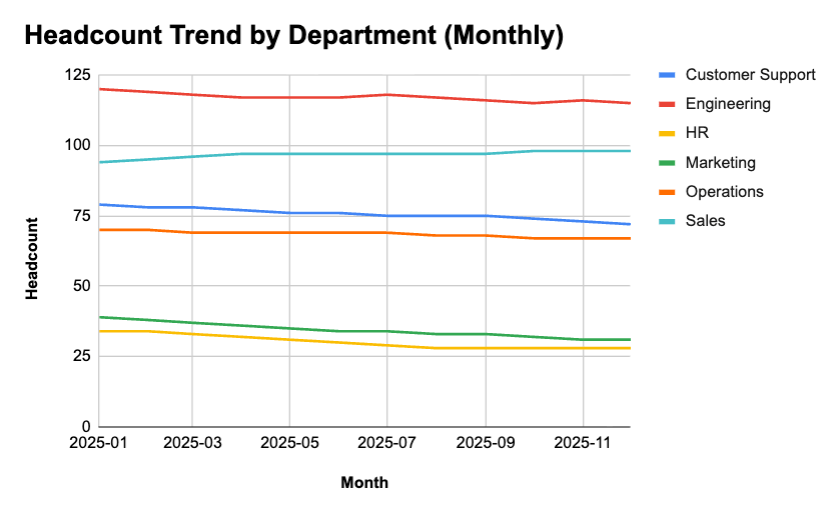
Results show uneven workforce dynamics across departments. While Sales experienced modest net growth, most other functions — particularly Customer Support, Marketing, HR, and Engineering — saw net declines driven by higher exits than hires. These patterns indicate capacity strain and highlight where replacement hiring or structural changes may be required.
Overall, the findings emphasize the importance of proactive workforce planning. Without targeted interventions, sustained attrition in key departments may impact service delivery, operational stability, and long-term growth objectives.
Business Questions
- How are recent hiring and attrition trends impacting workforce capacity across departments?
- Which functions are experiencing net growth versus net decline?
- Where does sustained attrition pose future operational or service delivery risk?
Data & Approach
- Monthly hiring and attrition data segmented by department
- Net headcount change calculated to identify growth and contraction trends
- Time-based analysis used to surface emerging workforce patterns
Key Insights
- Workforce dynamics varied significantly by department, with uneven patterns of hiring and attrition.
- Sales experienced modest net growth, while Customer Support, Marketing, HR, and Engineering saw net declines driven by higher exits than hires.
- Sustained attrition in several functions indicates potential capacity strain if trends continue.
Business Implications
- Proactive workforce planning is required to address sustained net declines in key departments.
- Replacement hiring, role redesign, or structural adjustments may be necessary to maintain service levels.
- Monitoring net headcount movement enables earlier intervention and supports long-term organizational stability.
 Anthony Dahl | Human Resources