Executive Summary
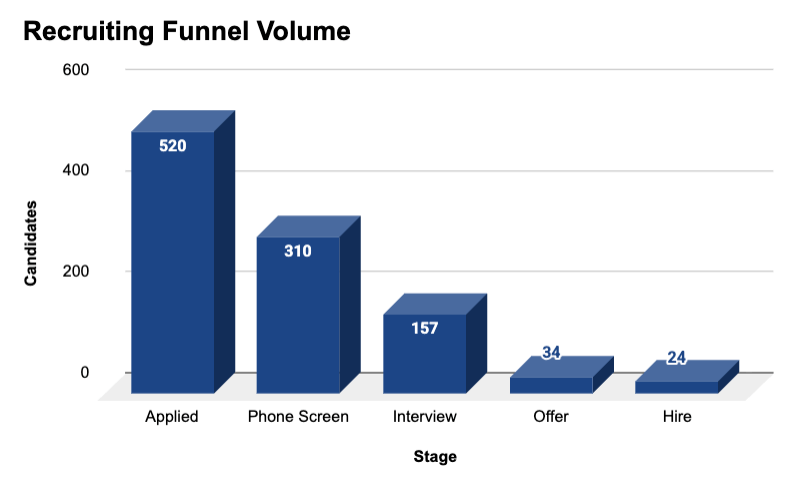
This project analyzed the company’s recruiting funnel to understand where candidates drop out and what drives delays in time-to-hire. Using candidate-level pipeline data, the analysis measured funnel conversion rates and median time spent at each hiring stage.
The findings show that hiring delays are concentrated early in the funnel, specifically between application and phone screening. Once candidates reach interviews, the hiring process moves efficiently and consistently. This indicates that overall time-to-hire is driven more by screening capacity and prioritization than by interview scheduling or offer decision delays.
Based on these insights, the project recommends focusing on early-stage process improvements—such as screening SLAs, recruiter workload balancing, and targeted automation—to meaningfully reduce time-to-hire without increasing sourcing volume or interview burden.
Business Questions
- Where in the recruiting funnel do candidates drop out at the highest rates?
- Which stages contribute most to delays in overall time-to-hire?
- Are hiring delays driven by early-stage screening or later interview and decision processes?
Data & Approach
- Candidate-level recruiting pipeline data spanning application through hire
- Funnel conversion rates calculated for each hiring stage
- Median time-in-stage measured to identify delay drivers
Key Insights
- Candidate drop-off and delays are concentrated early in the funnel, particularly between application and phone screening.
- Later-stage interviews and offer decisions progress efficiently, with minimal time accumulation once candidates advance past screening.
- Overall time-to-hire is driven more by screening capacity and prioritization than by interview scheduling or offer decisions.
Business Implications
- Improving early-stage screening throughput offers the highest impact opportunity to reduce time-to-hire.
- Clear screening SLAs, recruiter workload balancing, and selective automation can reduce delays without increasing sourcing volume.
- Optimizing early funnel stages improves candidate experience while preserving interview quality and hiring rigor.
 Anthony Dahl | Human Resources