Executive Summary
This analysis examined employee engagement across departments, tenure groups, and job levels to identify where engagement risk is highest and what factors most strongly influence employee experience. The results show meaningful variation in engagement, with customer-facing departments, early-tenure employees, and mid-level roles displaying consistently lower scores.
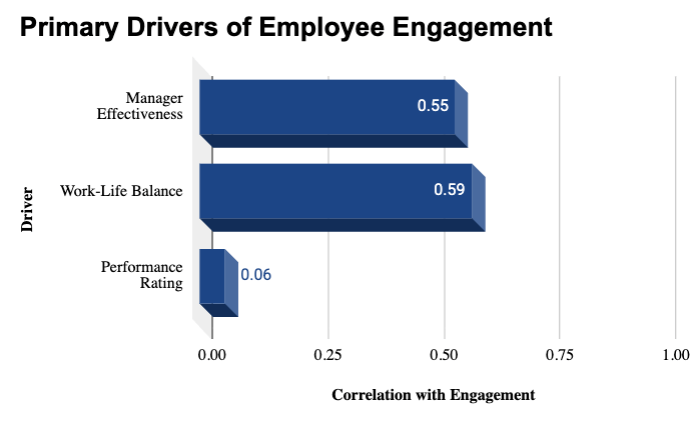
Driver analysis indicates that manager effectiveness is the strongest predictor of engagement, followed closely by work-life balance. In contrast, performance ratings show minimal correlation with engagement, suggesting that day-to-day management quality and workload sustainability matter more than formal evaluation outcomes.
Finally, engagement was found to be strongly linked to attrition. Employees with low engagement exhibit significantly higher turnover rates, confirming engagement as a leading indicator of retention risk and reinforcing the business value of targeted engagement interventions.
Business Questions
- Where is employee engagement risk highest across departments, tenure groups, and job levels?
- Which factors most strongly influence engagement outcomes?
- How does engagement relate to employee attrition risk?
Data & Approach
- Employee engagement survey data segmented by department, tenure, and role level
- Key experience dimensions including manager effectiveness, work-life balance, and performance ratings
- Correlation-based driver analysis to assess the strength of relationships between engagement and experience factors
Key Insights
- Engagement varies meaningfully across departments and employee segments, with lower scores among customer-facing teams, early-tenure employees, and mid-level roles.
- Manager effectiveness emerged as the strongest driver of engagement, followed closely by work-life balance.
- Performance ratings showed minimal correlation with engagement, indicating that day-to-day management quality matters more than formal evaluations.
Business Implications
- Engagement initiatives should prioritize manager capability and workload sustainability rather than broad engagement programs.
- Targeting high-risk segments enables more efficient use of engagement resources and improves retention outcomes.
- Because engagement is strongly linked to attrition, monitoring engagement trends provides an early warning system for turnover risk.
 Anthony Dahl | Human Resources