Executive Summary
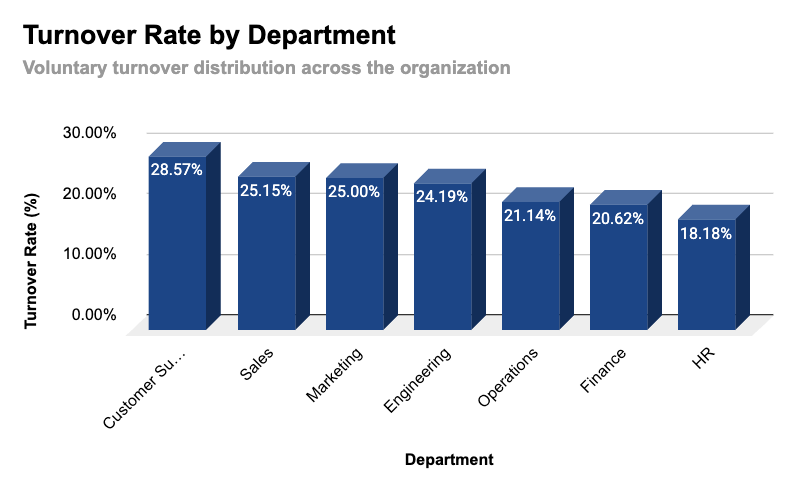
This case study analyzes employee turnover patterns across the organization to identify whether attrition was driven by individual employee factors or broader structural dynamics. The overall company turnover rate was 23.78%, with meaningful variation by department. Customer Support, Sales, and Marketing consistently experienced higher turnover than other functions, with Customer Support showing the highest rate at 28.57%, nearly five percentage points above the company average. These disparities pointed to potential role- or function-specific challenges rather than isolated employee issues.
Further analysis showed that employees who left and those who stayed reported nearly identical scores across key experience metrics, including engagement, work-life balance, and manager effectiveness. Differences in compensation, tenure, and performance were also minimal between groups, indicating that turnover was not primarily driven by dissatisfaction, pay inequity, or underperformance. Instead, the findings suggest that turnover was largely influenced by department-level dynamics and role characteristics, highlighting the need for targeted, function-specific retention strategies rather than individual-focused interventions.
Business Questions
- Is employee attrition driven by individual-level factors (engagement, performance, compensation), or by department- and role-level dynamics?
- Which functions exhibit elevated turnover risk relative to the company average?
- Where should retention interventions be focused to achieve the greatest impact?
Data & Approach
- Employee-level HR data including department, tenure, compensation, performance ratings, and employee experience survey scores
- Turnover outcomes segmented by department and role
- Comparative analysis between employees who exited and those who remained
Key Insights
- Turnover was unevenly distributed across departments, with Customer Support, Sales, and Marketing consistently exceeding the company average.
- Customer Support exhibited the highest turnover rate (28.57%), nearly five percentage points above the organizational baseline.
- Experience, compensation, tenure, and performance metrics showed minimal differences between employees who left and those who stayed.
Business Implications
- Retention risk is primarily structural, not individual, indicating that blanket engagement or compensation programs are unlikely to be effective.
- Targeted, function-specific interventions (role design, workload management, career pathways) are likely to produce higher ROI.
- Customer-facing functions should be prioritized for retention initiatives due to sustained elevated attrition risk.
 Anthony Dahl | Human Resources