Executive Summary
This analysis examined gender-based pay equity across roles to identify whether compensation differences exist after segmenting by job function. Rather than relying on a single company-wide average, the analysis focused on role-level comparisons to uncover more meaningful patterns.
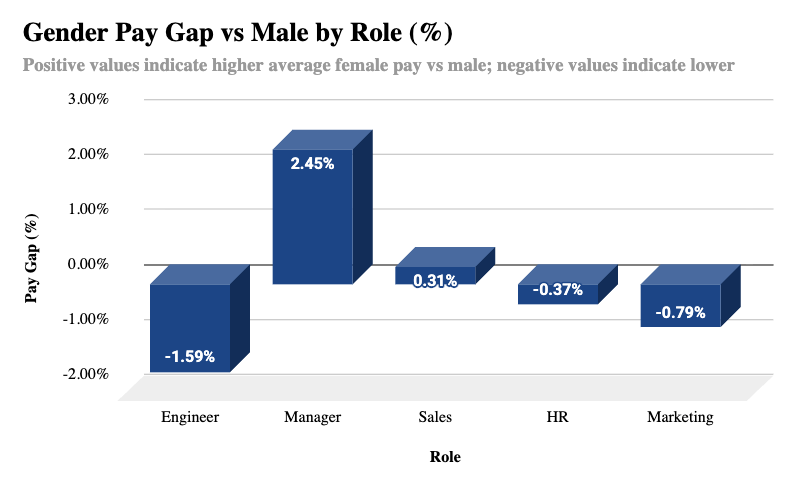
Results show that pay gaps vary by role, with some positions favoring female employees and others favoring male employees. Manager roles exhibit a positive pay gap for female employees, while Engineering and Marketing show modest negative gaps. Sales roles are largely pay-neutral, suggesting more consistent compensation structures.
Overall, while observed gaps are relatively small, they are directionally consistent across roles. These findings support the need for ongoing role-level pay audits and structured compensation reviews to ensure equity is maintained as the workforce evolves.
Business Questions
- Do gender-based compensation differences exist once pay is segmented by role?
- Are observed pay gaps consistent across functions or concentrated in specific roles?
- Where should equity reviews be prioritized to ensure fair and sustainable compensation practices?
Data & Approach
- Employee compensation data segmented by role, department, and gender
- Role-level comparisons used instead of company-wide averages
- Pay gap calculations conducted by role to isolate structural differences
Key Insights
- Pay gaps vary meaningfully by role, rather than following a single company-wide pattern.
- Some roles showed positive pay gaps favoring female employees, while others favored male employees.
- Manager roles exhibited a positive gap for female employees, while Engineering and Marketing showed modest negative gaps; Sales roles were largely pay-neutral.
Business Implications
- Company-wide averages are insufficient for equity monitoring; ongoing role-level pay audits are required.
- Equity reviews should be embedded into compensation planning cycles, particularly for roles with consistent directional gaps.
- Maintaining structured compensation frameworks helps ensure equity is preserved as the workforce grows and evolves.
 Anthony Dahl | Human Resources